Separate Similar Symptoms Before Replacing Parts
- Separate stopped-motor, unloaded no-lift and loaded no-retract symptoms.
- Select documented checks before condemning components.
- Work safely and report useful service information.
- Digital multimeter — Check power at the starter solenoid and motor, and assess battery and ground conditions.
- Insulated hand tools — Access electrical terminals and service connections after isolating power.
- Flashlight — Inspect wiring, the solenoid housing, inlet connections and accessible signs of corrosion.
- Combination wrenches — Service hydraulic connections only after supporting the load and depressurizing the system.
- Drain pan — Contain fluid released during authorized hydraulic inspection or service.
A motor that does not run requires a different diagnostic path from a running motor that produces no cylinder movement. The guide starts the no-run path with power at the starter solenoid, then power at the motor, followed by checking for motor rust if those electrical checks pass.
A clicking starter solenoid does not identify one certain failure. The source lists carbon on contacts, rust inside the motor, a loose solenoid-to-motor wire and a cracked solenoid housing. If the starter solenoid stays on, the guide associates welded contacts with low battery voltage or a poor ground and calls for replacement plus battery and ground checks.
When the motor runs without loading but cannot lift, the listed possibilities include low fluid, an inlet that admits air, a pump that has not primed and worn cylinder packing. A unit that struggles to lift can instead involve poor supply conditions, air at the pump inlet, a partly shifted directional valve or relief-seat debris.
For a double-acting cylinder that will not retract while the motor is loaded, the guide lists low battery, poor ground, an inactive load-holding coil, a directional valve that has not returned to its spring-offset position and bad cylinder packing. Reservoir overflow can also have electrical causes, as well as air in the system or an undersized reservoir.
A one-direction-only fault can involve a coil. The introductory troubleshooting page describes swapping coils to see whether the working direction changes; a change identifies a faulty coil in that check. Record the model, serial number and observed symptoms when seeking service assistance rather than reporting only that the hydraulics do not work.
How It Works
Motor behavior selects the diagnostic path
A stopped motor calls for checking power at the starter solenoid and then at the motor; if those checks pass, the guide directs a motor-rust check. A solenoid click indicates actuation, not proof that its contacts can deliver motor current, so clicking alone cannot identify the failed part.
Load response separates similar hydraulic complaints
A running motor that does not load during a lift command suggests a different path from a loaded motor during a failed retract command. Low fluid, inlet air or failure to prime can interrupt pump delivery, while worn cylinder packing can allow internal bypass. Directional-valve position and load-holding-coil operation can also determine whether flow reaches or leaves the cylinder.
Confirm the cause rather than adjusting around it
The guide describes swapping coils for a direction-specific fault; a change in the working direction identifies a faulty coil in that check. Treat other listed causes as possibilities to test, not replacement instructions, and never use relief adjustment as a substitute for diagnosis. Support moving equipment, isolate power as appropriate and depressurize hydraulic lines before hydraulic service.
Step-by-Step Procedure
0/7 doneFigures
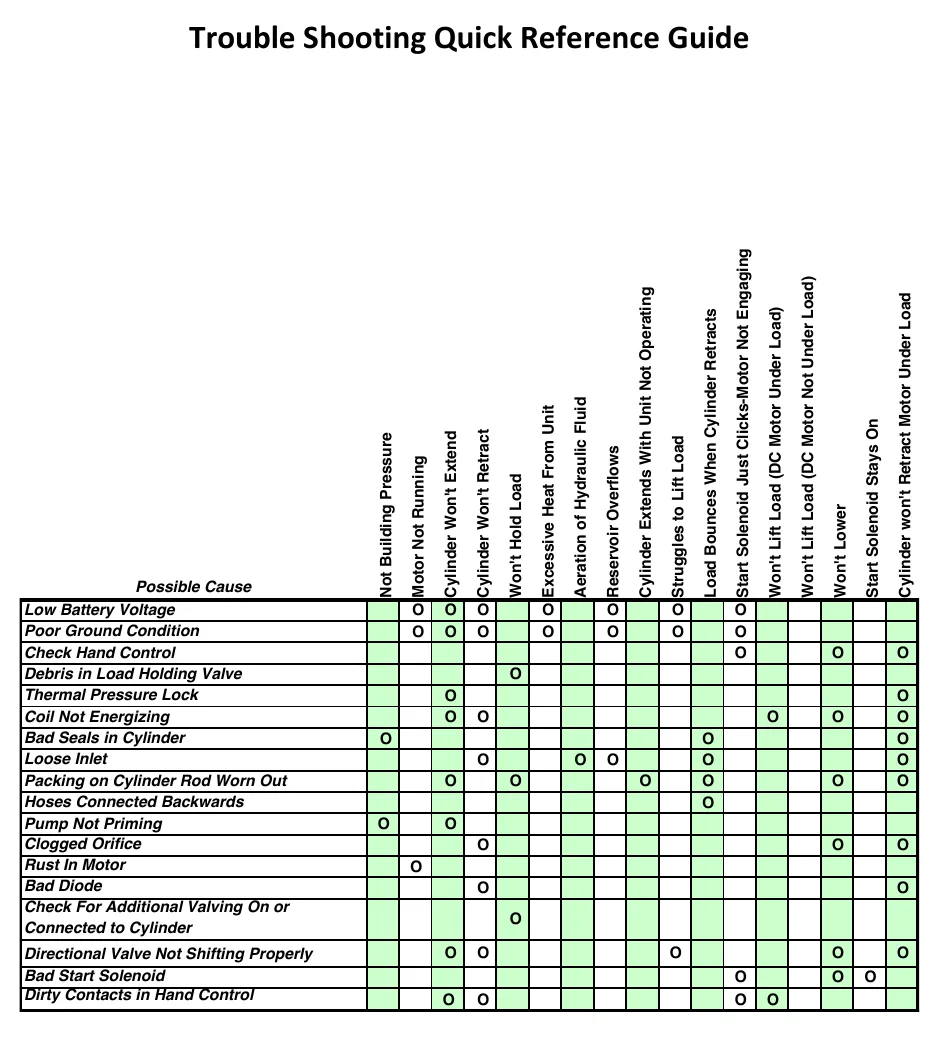
Diagnostic Chart
| Symptom | Check | Spec / Expected | Likely cause & fix |
|---|---|---|---|
| Motor does not run, with or without a starter-solenoid click | Check power at the starter solenoid, then at the motor; if both checks pass, inspect for motor rust as directed. For clicking, also inspect the solenoid-to-motor wire and solenoid housing, and investigate contact condition. | The documented sequence is starter-solenoid power, motor power, then motor rust; a click does not establish a certain failure. | Possible causes include carbon on contacts, motor rust, a loose solenoid-to-motor wire or a cracked solenoid housing. Basis: Hydraulics-Troubleshooting-Manual 2019 |
| Starter solenoid remains on | Address the solenoid and check battery condition and the ground rather than replacing the solenoid alone. | The guide calls for replacement for welded contacts, plus battery and ground checks. | Welded contacts associated with low battery voltage or a poor ground. Basis: Hydraulics-Troubleshooting-Manual 2019 |
| Motor runs but the cylinder will not lift, or struggles to lift | First determine whether the motor remains unloaded or struggles under load. For unloaded no-lift, check fluid, inlet air, priming and packing; for struggling lift, investigate supply conditions, inlet air, valve shift and relief-seat debris. | Keep unloaded no-lift separate from struggling lift; do not substitute relief adjustment for diagnosis. | Low fluid, inlet air, an unprimed pump or worn packing can cause unloaded no-lift; poor supply conditions, inlet air, partial directional-valve shift or relief-seat debris can cause struggling lift. Basis: Hydraulics-Troubleshooting-Manual 2019 |
| Double-acting cylinder will not retract while the motor is loaded | Check battery and ground, load-holding-coil operation, directional-valve return and cylinder packing. For a direction-specific fault, use the documented coil-swap check and observe whether the working direction changes. | The directional valve should return to its spring-offset position; a change in working direction during the documented swap identifies a faulty coil. | Low battery, poor ground, an inactive load-holding coil, failure of the directional valve to return or bad cylinder packing. Basis: Hydraulics-Troubleshooting-Manual 2019 |
At the Bay: Diagnose the Case
CASE 1 / 4
Motor does not run, with or without a starter-solenoid click
- Test
- Compare
- Correct
Select the next check
Basis: Hydraulics-Troubleshooting-Manual 2019. A likely cause is a hypothesis; confirm it with the applicable service procedure before repair.
Common Bay Mistakes
- ✕ Condemning a starter solenoid because it clicks.
- ✕ Replacing welded contacts without checking battery and ground.
- ✕ Assuming reservoir overflow is exclusively a fluid problem.
- ✕ Reporting only that hydraulics do not work instead of model, serial number and observed symptoms.
Quick Check
Practice only — not scored.
Plan the Service Sequence
Planning practice only. Follow the applicable manufacturer's instructions, employer safety program and qualified supervision on real equipment.
Plan the first action. Compare the service steps with the bay mistakes.
Hands-on: Shop Test Equipment
Hydraulic Pressure & Relief Gauge
0–5,000 psi gauge on the pump pressure port, DC clamp meter, battery voltmeter
🛠 Equip your bay for this test →Symptom: Routine check before a customer pickup.
Spec limits used
- 3,200 psi — Primary relief (factory preset) (KTI Hydraulics Troubleshooting Manual 2019)
- 1,500 psi — Secondary relief, circuit 111 (KTI Hydraulics Troubleshooting Manual 2019)
- below 9 V — Low-voltage alarm (KTI remote)
- illustrative only — Motor current & voltage drop (General shop practice)
Simulated readings for practice. Always follow the manufacturer's procedure and values on a real trailer.
Source: Hydraulics-Troubleshooting-Manual 2019 — 1-23