Advanced Symptom-Based Fault Isolation
- Classify faults by motor behavior, cylinder direction and motor load.
- Select the documented diagnostic branch before replacing components.
- Separate electrical supply faults from hydraulic causes without changing relief settings.
- Digital multimeter — Check power at the start solenoid and motor, and investigate battery supply and ground-path problems.
- Battery tester — Evaluate battery condition when clicking, continuous operation or loaded hydraulic symptoms point toward an electrical supply problem.
- Insulated hand tools — Inspect and service electrical connections after isolating electrical power.
- Inspection light — Inspect wiring, solenoid housing, pump inlet connections and visible evidence of leakage.
- Wrenches — Service hydraulic connections only after supporting the dump body and depressurizing the circuit.
- Drain pan — Contain fluid during depressurized hydraulic inspection or component service.
Describe the symptom before choosing a cause. A motor that does not run, a solenoid that only clicks and a running motor that does not lift a load have separate diagnostic lists. For a nonrunning motor, check power at the start solenoid and motor before investigating internal motor rust.
When the start solenoid clicks without engaging the motor, the manual lists carbon buildup on solenoid contacts, rust in the motor, a loose solenoid-to-motor wire and a cracked solenoid housing. If the solenoid remains on, low battery voltage or a poor ground may have welded its contacts; the manual calls for replacement and a battery and ground check.
Failure to lift while the motor is not under load directs attention to low fluid, a loose pump inlet introducing air, failure to prime and worn cylinder packing. A double-acting cylinder that will not retract while the motor is under load has a different list: low battery, poor ground, an inactive load-holding coil, a directional valve not returning to spring offset or damaged packing.
Reservoir overflow is not presented as a single-cause complaint. The manual lists low battery or poor ground on double-acting units, air in the system and insufficient reservoir size. For a unit struggling to lift, it also lists pump air ingestion, partial directional-valve shifting and relief-valve debris alongside battery and ground problems.
How It Works
Classify the observation before naming the fault
Record whether the motor is silent, the solenoid clicks, the motor stays on or cylinder motion fails; then record motor load and whether the circuit is double acting. A click indicates solenoid actuation but does not prove that its contacts or the motor circuit can carry operating current. For a nonrunning motor, check power at the start solenoid and motor before investigating internal rust.
Motor load and cylinder direction separate hydraulic branches
Failure to lift with the motor not under load directs attention toward low fluid, inlet air entry, failure to prime and worn cylinder packing. A double-acting cylinder that will not retract with the motor under load instead directs attention toward battery and ground condition, the load-holding coil, directional-valve return and damaged packing. Air can interrupt effective pump delivery, while leaking packing can allow internal bypass rather than useful cylinder movement.
Treat overflow and continuous operation as evidence, not verdicts
Reservoir overflow has several documented causes, including battery or ground problems on double-acting units, air in the system and insufficient reservoir size. Low battery voltage or a poor ground may contribute to welded start-solenoid contacts; confirmed welded contacts require replacement plus battery and ground checks. Do not change relief settings to compensate for an unresolved symptom, and depressurize hydraulic lines before hydraulic service.
Step-by-Step Procedure
0/6 doneFigures
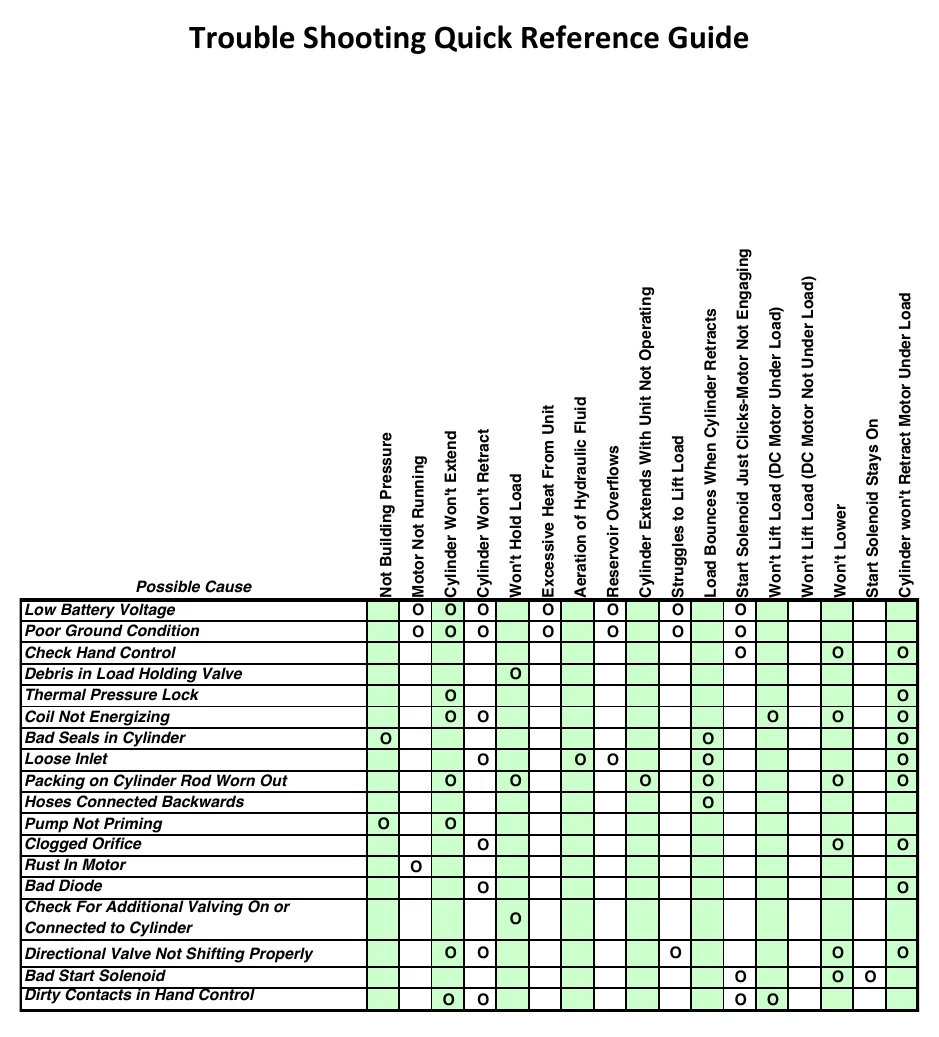
Diagnostic Chart
| Symptom | Check | Spec / Expected | Likely cause & fix |
|---|---|---|---|
| Motor does not run, or the start solenoid only clicks. | Distinguish silence from clicking. For a nonrunning motor, check power at the start solenoid and motor before inspecting for internal rust; for clicking, inspect the solenoid contacts, solenoid-to-motor wire, housing and motor condition. | Use the separate nonrunning-motor and clicking-solenoid diagnostic lists; clicking alone does not identify the failed component. | The clicking branch lists carbon buildup on solenoid contacts, motor rust, a loose solenoid-to-motor wire and a cracked solenoid housing. Basis: Hydraulics-Troubleshooting-Manual 2019 |
| Start solenoid remains on. | Determine whether the contacts have welded on, then check battery and ground condition rather than treating solenoid replacement as the complete repair. | Replace a start solenoid with welded contacts and check both battery and ground condition. | Low battery voltage or a poor ground may have contributed to welded contacts. Basis: Hydraulics-Troubleshooting-Manual 2019 |
| Cylinder fails to lift or a double-acting cylinder fails to retract. | Record commanded direction and whether the motor is under load. For unloaded failure to lift, inspect fluid supply, inlet integrity, priming and packing; for loaded failure to retract, check battery, ground, load-holding coil activity, directional-valve return and packing. | Unloaded failure to lift and loaded double-acting failure to retract require different documented diagnostic branches. | The lift branch lists low fluid, inlet air entry, failure to prime and worn packing; the retraction branch lists low battery, poor ground, an inactive load-holding coil, failed return to spring offset and damaged packing. Basis: Hydraulics-Troubleshooting-Manual 2019 |
| Reservoir overflows or the unit struggles to lift. | Separate overflow from weak lifting. For overflow, investigate air and reservoir size, plus battery and ground condition on double-acting units; for weak lifting, investigate battery, ground, pump air ingestion, partial directional-valve shifting and relief-valve debris. | Use the quick-reference chart together with detailed symptom descriptions; do not adjust relief settings to compensate for an unresolved complaint. | Overflow and weak lifting have multiple possible causes and are not proof of a single failed component. Basis: Hydraulics-Troubleshooting-Manual 2019 |
At the Bay: Diagnose the Case
CASE 1 / 4
Motor does not run, or the start solenoid only clicks.
- Test
- Compare
- Correct
Select the next check
Basis: Hydraulics-Troubleshooting-Manual 2019. A likely cause is a hypothesis; confirm it with the applicable service procedure before repair.
Common Bay Mistakes
- ✕ Treating a solenoid click as proof that the motor has failed.
- ✕ Ignoring motor load or cylinder direction when choosing a branch.
- ✕ Replacing welded contacts without checking battery and ground condition.
- ✕ Changing relief settings to mask an unresolved lifting complaint.
Quick Check
Practice only — not scored.
Plan the Service Sequence
Planning practice only. Follow the applicable manufacturer's instructions, employer safety program and qualified supervision on real equipment.
Plan the first action. Compare the service steps with the bay mistakes.
Hands-on: Shop Test Equipment
Hydraulic Pressure & Relief Gauge
0–5,000 psi gauge on the pump pressure port, DC clamp meter, battery voltmeter
🛠 Equip your bay for this test →Symptom: Routine check before a customer pickup.
Spec limits used
- 3,200 psi — Primary relief (factory preset) (KTI Hydraulics Troubleshooting Manual 2019)
- 1,500 psi — Secondary relief, circuit 111 (KTI Hydraulics Troubleshooting Manual 2019)
- below 9 V — Low-voltage alarm (KTI remote)
- illustrative only — Motor current & voltage drop (General shop practice)
Simulated readings for practice. Always follow the manufacturer's procedure and values on a real trailer.
Source: Hydraulics-Troubleshooting-Manual 2019 — 20-22