Interpreting Hoist Capacity Charts
- Match the hoist model, body geometry and dump angle to the correct chart entry.
- Recognize the load, hinge-height and relief-pressure assumptions behind capacity.
- Document the selected capacity without treating it as a lifting guarantee.
- Tape measure — Verify body length, overhang and hinge-pivot-to-floor separation using the chart's reference points.
- Digital angle finder — Check body angle when the body is safely supported under the manufacturer's procedure.
- Flashlight — Read the hoist identification plate and inspect hinge and floor reference points.
- Inspection mirror — View identification markings or reference points without entering a pinch zone.
- Hydraulic pressure gauge — Allow a qualified technician to verify pressure using an appropriately rated gauge and the manufacturer's test procedure, not to adjust pressure to match a chart.
A hoist capacity chart is an application guide, not an unconditional lifting guarantee. The supplied chart explicitly warns that application differences affect its use. Start with the correct hoist table rather than choosing a capacity from a nearby row or a different model.
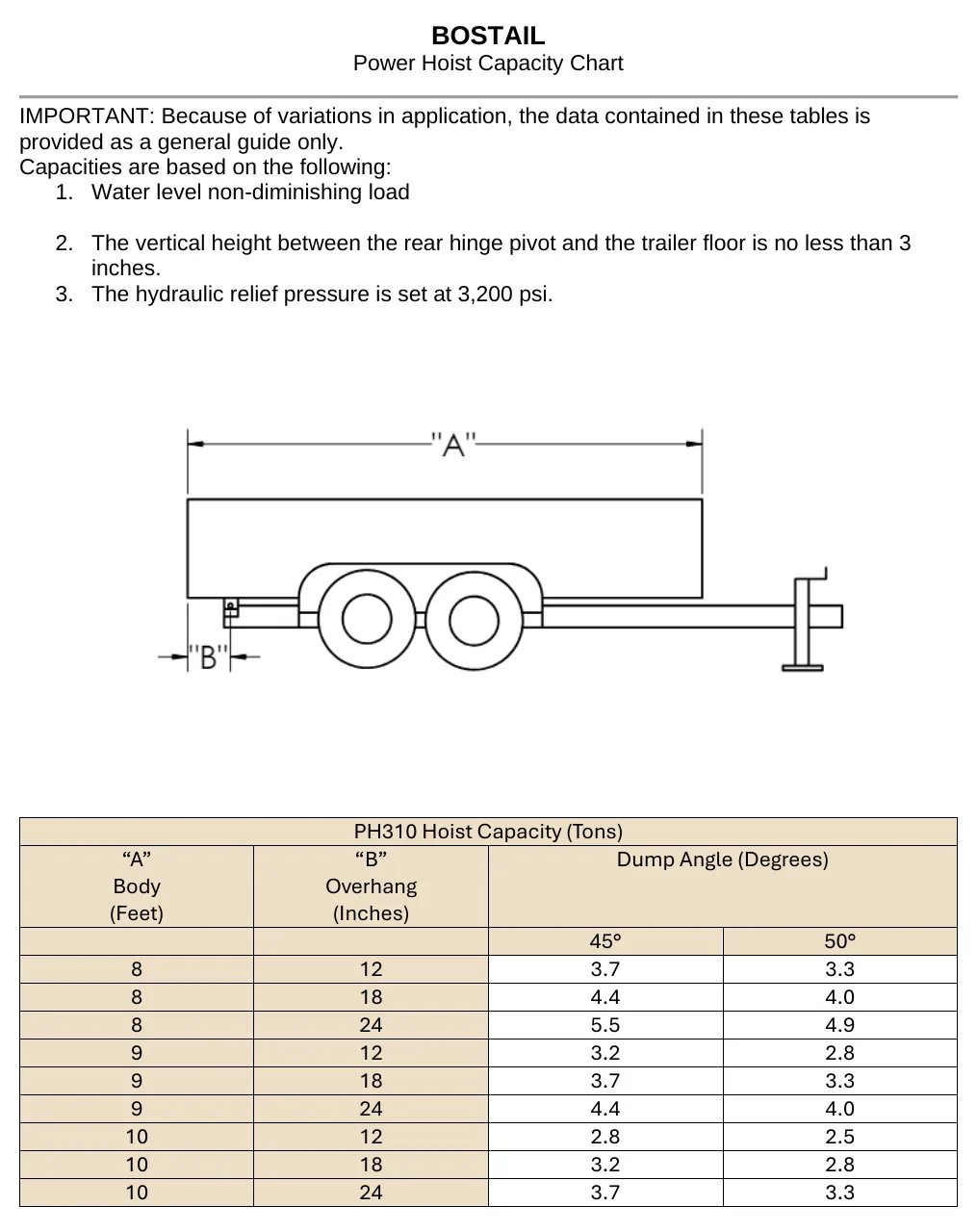
The chart bases its capacities on a water-level, non-diminishing load. Bostail also specifies at least 3 inches of vertical separation between the rear hinge pivot and trailer floor and a hydraulic relief setting of 3,200 psi. These are chart assumptions, not instructions to adjust another system; values vary by maker.
Read body length and overhang together before selecting the dump-angle column. For example, Bostail lists its PH310 with an 8-foot body and 18-inch overhang at 4.4 tons for 45 degrees and 4.0 tons for 50 degrees. Values vary by maker and application.
Keep every comparison tied to its full configuration. Bostail lists its PH416 with a 12-foot body, 18-inch overhang and 45-degree dump angle at 8.3 tons; its PH516 at that same geometry is listed at 8.6 tons. Values vary by maker, so similar geometry does not establish identical capacity across hoists.
How It Works
Capacity belongs to a complete configuration
Begin with the correct hoist table, match body length and overhang together, and then read the intended dump-angle column. Body geometry changes the load's leverage about the rear hinge, while hoist geometry affects the lifting leverage available. A nearby row or similar hoist is not a substitute for the matching configuration.
Chart assumptions remain attached to the rating
The Bostail chart assumes a water-level, non-diminishing load, at least 3 inches of vertical separation between the rear hinge pivot and trailer floor, and a relief setting of 3,200 psi. Water-level describes a level load surface, while non-diminishing means the assumed load does not decrease during the lift. These are application assumptions rather than permission to alter another system, and the chart remains a general guide rather than an unconditional lifting guarantee.
Angle and model comparisons must stay specific
Bostail lists the PH310 with an 8-foot body and 18-inch overhang at 4.4 tons for 45 degrees and 4.0 tons for 50 degrees. With a 12-foot body, 18-inch overhang and 45-degree dump angle, its PH416 is listed at 8.3 tons and its PH516 at 8.6 tons. These examples show why a capacity must retain its model, geometry and angle; values vary by maker and application.
Step-by-Step Procedure
0/5 doneBostail chart examples and assumptions; values vary by maker
| Minimum hinge-pivot-to-floor vertical height | 3 inches |
| Relief-pressure assumption | 3,200 psi |
| PH310: 8-foot body, 18-inch overhang, 45 degrees | 4.4 tons |
| PH310: 8-foot body, 18-inch overhang, 50 degrees | 4.0 tons |
Figures
Diagnostic Chart
| Symptom | Check | Spec / Expected | Likely cause & fix |
|---|---|---|---|
| A capacity is quoted without a confirmed hoist model. | Read the hoist identification and compare it with the table heading before selecting a row. | Use the table for the identified hoist; do not substitute a nearby model's capacity. | The selection may have been taken from a different hoist table. Basis: Bostail Power Hoist Capacity Chart |
| Different technicians quote different capacities for the same body. | Compare the recorded model, body length, overhang and intended dump-angle column. | PH310 with an 8-foot body and 18-inch overhang: 4.4 tons at 45 degrees; 4.0 tons at 50 degrees. | A different angle column or an incomplete geometry match may explain the disagreement. Basis: Bostail Power Hoist Capacity Chart |
| The trailer application does not clearly match the selected chart assumptions. | Review load shape and whether the load diminishes, verify hinge-to-floor separation, and compare documented hydraulic settings with the applicable manufacturer's requirements. | Bostail assumptions: water-level, non-diminishing load; at least 3 inches of vertical separation; relief setting of 3,200 psi. | Application differences can make the selected entry unsuitable as a direct capacity claim. Basis: Bostail Power Hoist Capacity Chart |
| A hoist struggles to raise a load believed to be within the chart capacity. | Stop the lifting attempt, secure the equipment under the manufacturer's procedure, and confirm the complete chart selection and its assumptions before further troubleshooting. | The chart is a general guide only; its relief-pressure assumption does not authorize relief-valve adjustment. | The application may differ from the chart assumptions; lifting difficulty alone does not establish that relief pressure should be increased. Basis: Bostail Power Hoist Capacity Chart |
At the Bay: Diagnose the Case
CASE 1 / 4
A capacity is quoted without a confirmed hoist model.
- Test
- Compare
- Correct
Select the next check
Basis: Bostail Power Hoist Capacity Chart. A likely cause is a hypothesis; confirm it with the applicable service procedure before repair.
Common Bay Mistakes
- ✕ Choosing a plausible capacity before confirming the hoist model.
- ✕ Matching body length while ignoring overhang or dump angle.
- ✕ Treating similar geometry as proof of identical hoist capacity.
- ✕ Raising relief pressure to force agreement with a chart assumption.
Quick Check
Practice only — not scored.
Plan the Service Sequence
Planning practice only. Follow the applicable manufacturer's instructions, employer safety program and qualified supervision on real equipment.
Plan the first action. Compare the service steps with the bay mistakes.
Hands-on: Shop Test Equipment
Hydraulic Pressure & Relief Gauge
0–5,000 psi gauge on the pump pressure port, DC clamp meter, battery voltmeter
🛠 Equip your bay for this test →Symptom: Routine check before a customer pickup.
Spec limits used
- 3,200 psi — Primary relief (factory preset) (KTI Hydraulics Troubleshooting Manual 2019)
- 1,500 psi — Secondary relief, circuit 111 (KTI Hydraulics Troubleshooting Manual 2019)
- below 9 V — Low-voltage alarm (KTI remote)
- illustrative only — Motor current & voltage drop (General shop practice)
Simulated readings for practice. Always follow the manufacturer's procedure and values on a real trailer.
Source: Bostail Power Hoist Capacity Chart — 1-2