Identification Records, VIN Scope and Catalog Data
- Separate axle catalog information from trailer identification evidence.
- Interpret HF, SC and brake fields without substituting between columns.
- Recognize service identifier requirements and document unresolved questions.
- Flashlight — Improve visibility when examining accessible markings without assuming an identifier location.
- Inspection mirror — View accessible surfaces without treating a marking's position as proof of its identity.
- Shop rag — Gently remove loose dirt so existing markings can be read without damaging them.
- Camera — Record legible markings and their surrounding context for service communication.
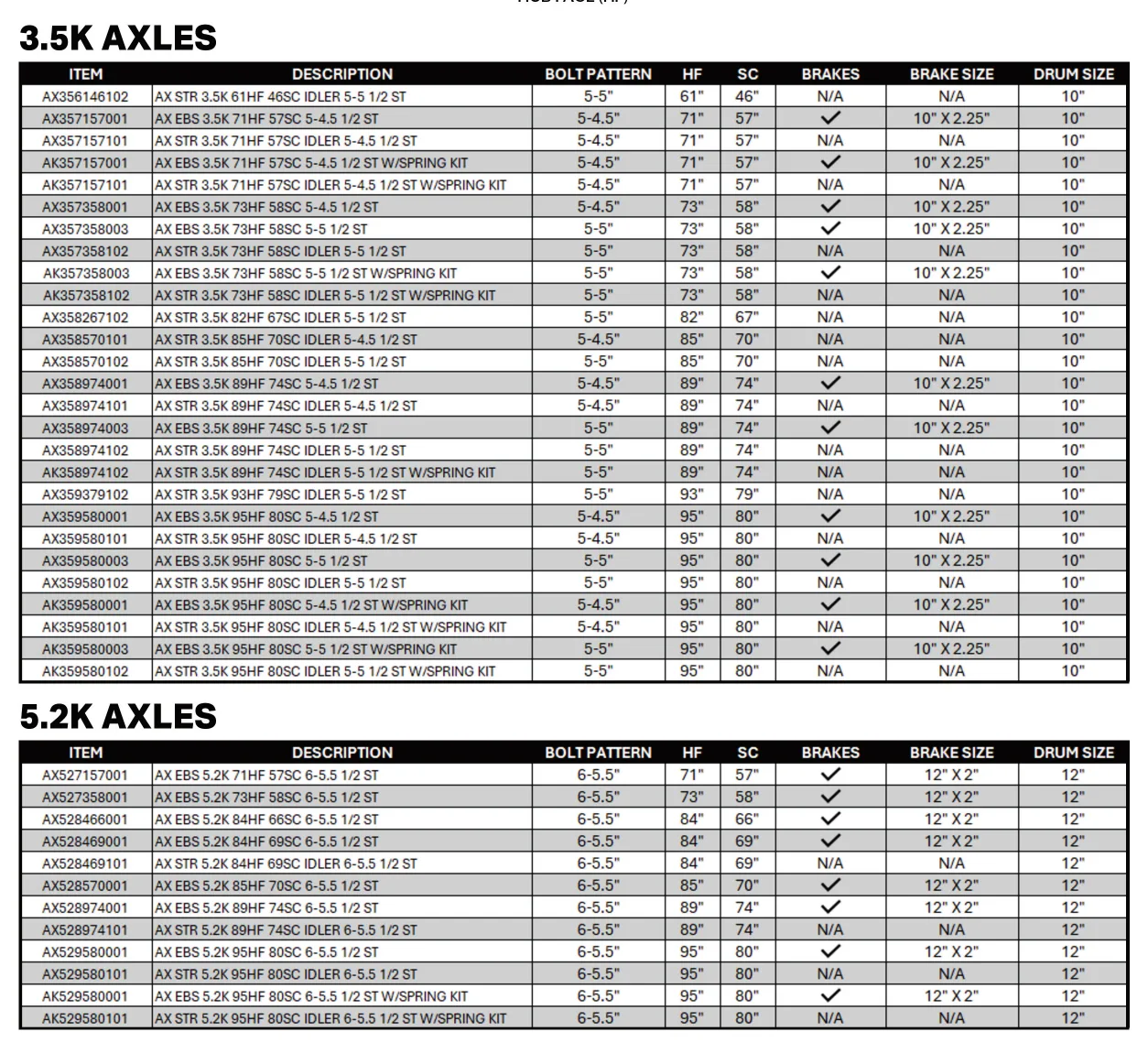
Identification starts with knowing what a document actually identifies. The supplied purchasing guide organizes axle information into item descriptions, bolt patterns, dimensions and brake details. Its columns describe axle configurations; the supplied material does not establish a trailer VIN-decoding method.
The guide labels HF as hub face and SC as spring center. These are separate dimension fields. Brake availability, brake size and drum size also have separate columns, so information in one column should not be substituted for information in another.
The supplied axle-identification excerpt asks the owner to have the axle lot, or serial, number available when requesting service assistance. That supports using an axle identifier for service communication, but the excerpt is incomplete and does not establish the identifier's full format or location. See LDServiceOnline, page 87.
The supplied material does not provide a complete trailer VIN-location procedure, VIN character decoding, or a trailer certification/data-plate layout. This module therefore teaches documented axle identification, catalog fields and weight-rating terminology without presenting unsupported VIN or plate instructions.
How It Works
Catalog descriptions are not VIN instructions
The purchasing guide organizes axle configurations by item description, bolt pattern, dimensions and brake details. These fields describe equipment choices; they do not establish a trailer VIN-decoding method, VIN location or certification-plate layout. A technician must distinguish what a document states from what a similar-looking component merely suggests.
Dimension and brake fields have distinct meanings
HF means hub face, while SC means spring center; these are separate dimension fields and are not interchangeable. Brake availability, brake size and drum size also occupy separate columns. Keeping each entry attached to its heading prevents an equipment description from becoming an unsupported fitment or brake specification.
Service identification has evidence limits
The axle-identification excerpt requests the axle lot, or serial, number when seeking service assistance. The lesson points to LDServiceOnline, page 87, but notes that the excerpt does not establish the identifier's full format or location. Record what is actually legible and leave unsupported identifier, VIN and plate questions unresolved.
Step-by-Step Procedure
0/6 doneFigures
Diagnostic Chart
| Symptom | Check | Spec / Expected | Likely cause & fix |
|---|---|---|---|
| An axle dimension has been recorded without its field heading. | Return to the purchasing guide and determine whether the entry belongs to HF or SC before using it. | HF means hub face; SC means spring center. | A dimension was copied without preserving what it describes. Basis: APEX AXLE PURCHASING GUIDE |
| A brake or drum specification was selected from the availability field. | Read brake availability, brake size and drum size under their own column headings. | Brake availability, brake size and drum size are separate fields. | Information from a related column was substituted for the required specification. Basis: APEX AXLE PURCHASING GUIDE |
| Service communication includes an axle description but no confirmed axle identifier. | Determine whether the axle lot or serial number has been recorded; do not guess its format or location from the incomplete excerpt. | The excerpt requests the axle lot, or serial, number for service assistance but does not establish its full format or location. | Catalog configuration information was mistaken for the requested service identifier. Basis: APEX AXLE PURCHASING GUIDE |
| A VIN interpretation or plate layout is being justified using the axle table. | Identify whether the supplied text actually supports the claim and mark the question unresolved when it does not. | The supplied material provides no complete VIN-location procedure, VIN character decoding or trailer certification/data-plate layout. | Axle catalog evidence was extended beyond its documented scope. Basis: APEX AXLE PURCHASING GUIDE |
At the Bay: Diagnose the Case
CASE 1 / 4
An axle dimension has been recorded without its field heading.
- Test
- Compare
- Correct
Select the next check
Basis: APEX AXLE PURCHASING GUIDE. A likely cause is a hypothesis; confirm it with the applicable service procedure before repair.
Common Bay Mistakes
- ✕ Treating an axle configuration listing as trailer VIN evidence.
- ✕ Copying a dimension without its HF or SC heading.
- ✕ Using brake availability as a brake or drum size.
- ✕ Guessing an identifier's format or location from an incomplete excerpt.
Quick Check
Practice only — not scored.
Plan the Service Sequence
Planning practice only. Follow the applicable manufacturer's instructions, employer safety program and qualified supervision on real equipment.
Plan the first action. Compare the service steps with the bay mistakes.
Source: APEX AXLE PURCHASING GUIDE — 1