Check Loading, Level Tow, and Axle Alignment
- Evaluate loading against vehicle, axle, tire, and component ratings.
- Assess loaded frame attitude and calculate individual axle loads.
- Check axle alignment using hitch-center and spindle-center references.
- Tape measure — Compare hitch-center-to-spindle-center measurements and check axle parallelism.
- Spirit level — Check ground level in both directions and assess loaded frame attitude.
- Plumb bob — Transfer hitch and spindle center references to the ground for repeatable measurements.
- Chalk — Mark measurement references without losing the selected center points.
- Wheel chocks — Secure the parked trailer before inspecting or marking alignment references.
The trailer certification label identifies gross vehicle weight rating and gross axle weight rating. Gross vehicle weight rating combines trailer load capacity with empty trailer weight, while gross axle weight rating describes the manufacturer's load-carrying rating for an individual axle. Loading must also respect tire ratings and the weakest rated component.
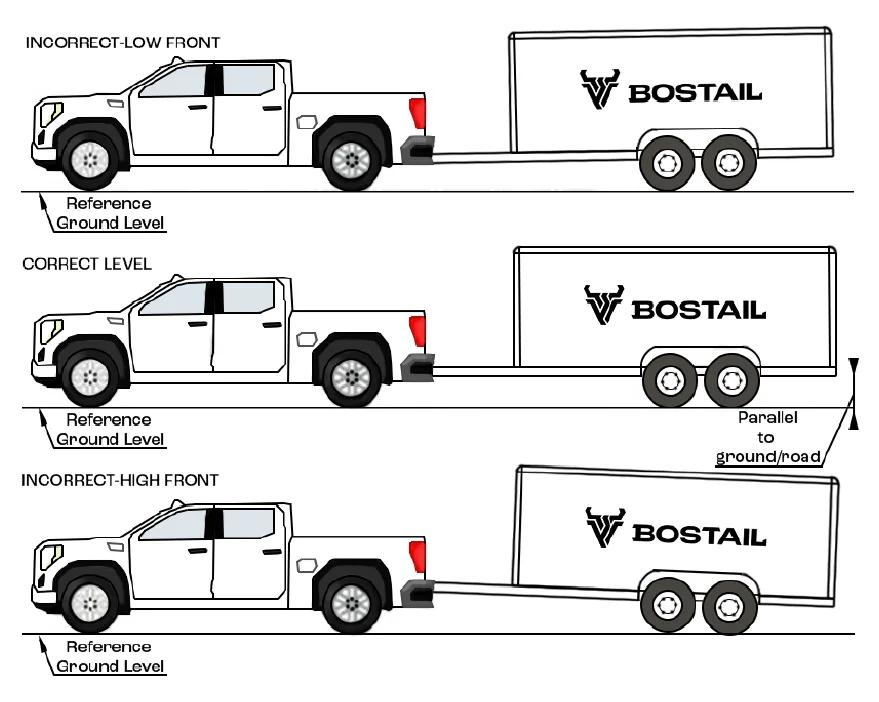
Cargo concentrated too far forward or rearward produces uneven axle loading. On ground that is level in both directions, view the loaded trailer from a distance and check that its frame is level with the ground. Excess axle loading can contribute to wear and sway.
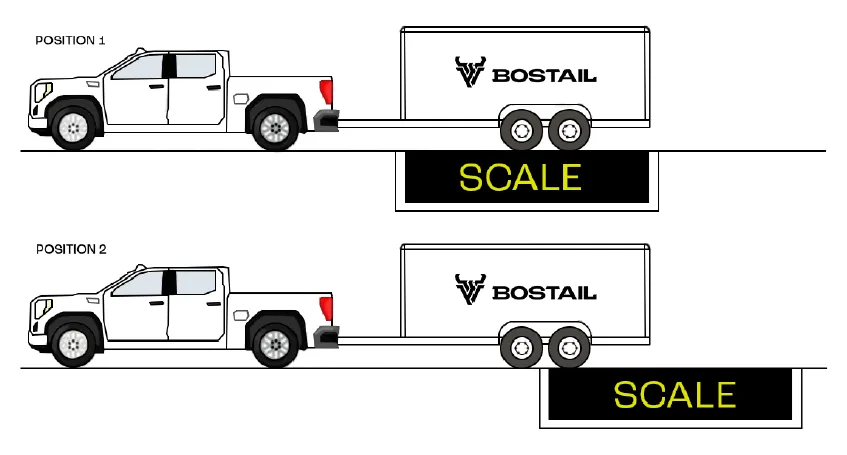
A certified truck scale provides the most accurate weight-distribution check described in the source. For the illustrated tandem arrangement, subtract the rear-only reading from the combined axle reading to obtain front axle weight; the rear-only reading is rear axle weight. For the illustrated triple arrangement, subtract successive readings to isolate the front and middle axle loads.
Axle installation also affects tracking. Establish the first axle square to the trailer centerline using measurements from the hitch center to the spindle centers, then align the remaining axles parallel to it. Proper alignment supports control and tread life and helps prevent dog-tracking.
How It Works
Ratings govern the loading decision
The certification label identifies gross vehicle weight rating and gross axle weight rating; gross vehicle weight rating combines empty trailer weight with trailer load capacity, while gross axle weight rating applies to an individual axle. Loading must also respect tire ratings and the weakest rated component, so an acceptable total weight does not establish that every axle or component is safely loaded. Overloading can cause loss of control and serious injury.
Frame attitude and scale readings answer different questions
On ground that is level in both directions, view the loaded trailer from a distance and check that its frame is level with the ground; forward or rearward cargo concentration can produce uneven axle loading. A certified truck scale provides the most accurate weight-distribution check described in the source: for the illustrated tandem arrangement, subtract the rear-only reading from the combined axle reading to obtain front axle weight, while the rear-only reading gives rear axle weight. For the illustrated triple arrangement, use the source's illustrated scale positions and subtract successive readings to isolate front and middle axle loads rather than assuming that a level-looking trailer has balanced axle loads.
Alignment starts with a trustworthy reference
Establish the first axle square to the trailer centerline using measurements from hitch center to spindle centers, then align the remaining axles parallel to it. An axle that is skewed relative to the intended travel direction makes its tires scrub sideways as they roll, promoting tread wear and poor tracking. Proper alignment supports control and tread life and helps prevent dog-tracking.
Step-by-Step Procedure
0/6 doneFigures
Diagnostic Chart
| Symptom | Check | Spec / Expected | Likely cause & fix |
|---|---|---|---|
| Trailer appears heavily loaded, but its allowable load is uncertain. | Read the certification label, obtain scale measurements, and compare loading with vehicle, individual axle, tire, and weakest-component ratings. | Do not exceed vehicle, axle, or tire ratings; loading must respect the weakest rated component. | Cargo weight may exceed a governing rating even when another rating remains acceptable. Basis: Bostail 8K Axle Manual |
| Loaded frame appears nose-high or nose-low, or axle loading appears uneven. | Verify that the ground is level in both directions, view the loaded frame from a distance, and evaluate cargo placement before confirming axle loads on a certified truck scale. | The loaded frame should be level with the ground, and cargo should be distributed evenly. | Cargo concentrated too far forward or rearward can produce uneven axle loading. Basis: Bostail 8K Axle Manual |
| Combined axle weight is known, but individual axle loading is not. | Use the source's illustrated scale positions. For the tandem arrangement, subtract the rear-only reading from the combined axle reading; for the triple arrangement, subtract the appropriate successive readings. | For the illustrated tandem arrangement, the difference is front axle weight and the rear-only reading is rear axle weight; successive triple readings isolate front and middle axle loads. | A combined reading conceals how the load is shared among individual axles. Basis: Bostail 8K Axle Manual |
| Trailer dog-tracks or shows tread wear consistent with poor tracking. | Measure from hitch center to spindle centers to check the first axle against the trailer centerline, then check the remaining axles for parallel alignment. | Establish the first axle square to the trailer centerline and align the remaining axles parallel to it; the lesson provides no numerical alignment tolerance. | Axle installation or alignment may direct the wheels away from the intended tracking path. Basis: Bostail 8K Axle Manual |
At the Bay: Diagnose the Case
CASE 1 / 4
Trailer appears heavily loaded, but its allowable load is uncertain.
- Test
- Compare
- Correct
Select the next check
Basis: Bostail 8K Axle Manual. A likely cause is a hypothesis; confirm it with the applicable service procedure before repair.
Common Bay Mistakes
- ✕ Treating an acceptable total weight as proof that every axle and tire is within rating.
- ✕ Using a level-looking frame as a substitute for scale measurements.
- ✕ Subtracting scale readings without verifying the illustrated wheel positions.
- ✕ Making additional axles parallel to an unchecked reference axle.
Quick Check
Practice only — not scored.
Plan the Service Sequence
Planning practice only. Follow the applicable manufacturer's instructions, employer safety program and qualified supervision on real equipment.
Plan the first action. Compare the service steps with the bay mistakes.
Hands-on: Shop Test Equipment
Dial Indicator — Bearing End Play
Magnetic-base dial indicator (0.001 in) on the hub face, spindle nut adjustment
🛠 Equip your bay for this test →Symptom: Bearing service — set end play after repack.
Spec limits used
- 0.001–0.010 in — Allowable end play, double-nut wheel end (Dexter 9-15K service manual, p.64)
- 0.008 in — Nev-R-Lube 50 mm max axial end play (Dexter 059-831-00)
- illustrative only — Face runout limit (General shop practice)
Simulated readings for practice. Always follow the manufacturer's procedure and values on a real trailer.
Source: Bostail 8K Axle Manual — 11-13, 49