Adjust Track Rods and Preserve Alignment
- Adjust axle alignment through the specified track rods.
- Secure clamps and verify alignment after tightening.
- Identify wear and maintenance needs that threaten alignment retention.
- Wheel chocks and rated support stands — Prevent unintended trailer movement and support the trailer safely when access requires lifting.
- Tape measure and plumb bob — Transfer reference points and compare axle position to the kingpin or coupler and adjacent axle.
- Socket set and wrenches — Release track-rod clamps and rotate the adjustable center rod using suitable wrenching surfaces.
- Torque wrench — Tighten identified clamp nuts to the applicable manufacturer specification.
- Inspection light and pry bar — Inspect leaves, liners, clamps, and track-arm joints; apply controlled pressure to help locate slack.
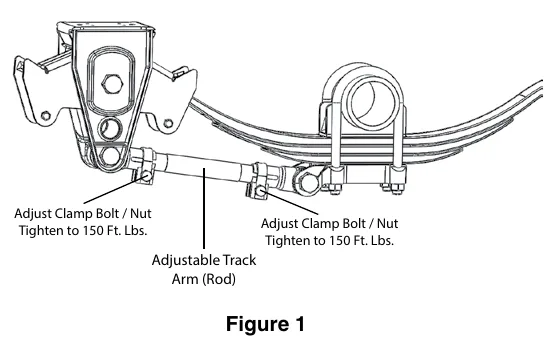
The described four-spring suspension uses an adjustable track rod on each axle, normally on the road side. Align the front axle to the kingpin or coupler, then align the rear axle parallel to the front. The rod adjustment is the specified correction method for this suspension.
Loosen the track-rod clamps and rotate the center rod to change alignment. Secure the clamps afterward, then repeat the measurements and readjust if necessary. Dexter specifies 150 ft-lb for the identified heavy-duty track-rod clamp nuts with clean, dry threads; values vary by maker.
An adjustment cannot remain reliable if the retaining components are worn or loose. Track-arm slack indicates wear in the rubber bushing or other track-arm parts and requires immediate repair. Loose clamps wear the adjusting threads and prevent the suspension from holding alignment.
Include leaf condition and equalizer position in follow-up maintenance. Replace broken leaves promptly and verify that the liners are serviceable and correctly positioned. Dexter calls for a leaf-spring alignment check after 2,000–3,000 miles and bolt/nut torque checks after initial break-in, up to 1,000 miles, and at least every four months afterward; these intervals vary by maker.
How It Works
Establish the axle relationship in the correct sequence
On the described suspension, an adjustable track rod on each axle, normally on the road side, provides the specified alignment correction. Align the front axle to the kingpin or coupler, then align the rear axle parallel to the front. Loosen the clamps and rotate the center rod to change axle position rather than forcing the axle against secured hardware.
Retention matters as much as adjustment
Tightening the clamps locks the adjustment, but the alignment must be measured again afterward to confirm the final axle relationship. Dexter specifies 150 ft-lb for the identified 5/8-11 UNC heavy-duty track-rod clamp nuts with clean, dry threads; do not transfer that specification to unidentified hardware or another maker. Track-arm slack permits axle movement under load, while loose clamps allow movement that wears the adjusting threads.
Maintain the surrounding suspension
Repair track-arm slack immediately, replace broken leaves promptly, and verify that liners are serviceable and correctly positioned. Check equalizer position and level equalizers parallel to the frame before torquing their bolts. Dexter calls for an alignment check after 2,000–3,000 miles and bolt/nut torque checks after initial break-in, up to 1,000 miles, then at least every 4 months; confirm the applicable maker's requirements.
Step-by-Step Procedure
0/8 doneDexter heavy-duty retention requirements; values vary by maker
| Track-rod clamp nut, 5/8-11 UNC, clean dry threads | 150 ft-lb |
| Leaf-spring axle alignment follow-up | After 2,000–3,000 miles |
| Bolt and nut torque follow-up | After initial break-in, up to 1,000 miles, then at least every 4 months |
Figures
Diagnostic Chart
| Symptom | Check | Spec / Expected | Likely cause & fix |
|---|---|---|---|
| Measurements show an incorrect axle relationship. | Identify the adjustable rod for the affected axle. Establish front-axle alignment to the kingpin or coupler before using the front axle as the rear-axle reference. | Use center-rod rotation with the clamps loosened; secure the clamps and remeasure before accepting the adjustment. | The rod setting may be incorrect, or the rear axle may have been referenced to a front axle that was not aligned. Basis: 9-15k complete service manual |
| Alignment changes after adjustment and clamp tightening. | Remeasure the axle relationship after securing the clamps. Check clamp tightness and inspect adjusting threads for wear if loose clamps are found. | Identified Dexter 5/8-11 UNC heavy-duty track-rod clamp nuts: 150 ft-lb with clean, dry threads; values vary by maker. | Loose clamps allow adjusting-thread wear and prevent reliable alignment retention. Basis: 9-15k complete service manual |
| Slack is present at a track arm. | Inspect the rubber bushing and other track-arm components to locate the worn or loose joint before attempting to finalize alignment. | Repair track-arm slack immediately. | Wear in the rubber bushing or other track-arm parts allows movement that an alignment adjustment cannot reliably correct. Basis: 9-15k complete service manual |
| Follow-up inspection finds broken leaves, displaced liners, or an incorrect equalizer position. | Inspect leaf condition and liner placement, and verify equalizer position before torquing equalizer bolts. | Replace broken leaves promptly; liners must be serviceable and correctly positioned. Level equalizers parallel to the frame before torquing their bolts. | Damaged spring components or incorrect suspension positioning can undermine alignment retention. Basis: 9-15k complete service manual |
At the Bay: Diagnose the Case
CASE 1 / 4
Measurements show an incorrect axle relationship.
- Test
- Compare
- Correct
Select the next check
Basis: 9-15k complete service manual. A likely cause is a hypothesis; confirm it with the applicable service procedure before repair.
Common Bay Mistakes
- ✕ Aligning the rear axle to an unverified front axle.
- ✕ Applying the Dexter clamp torque to unidentified hardware or lubricated threads.
- ✕ Treating track-arm slack as something rod adjustment can correct.
- ✕ Skipping measurements after clamp tightening or overlooking retention maintenance.
Quick Check
Practice only — not scored.
Plan the Service Sequence
Planning practice only. Follow the applicable manufacturer's instructions, employer safety program and qualified supervision on real equipment.
Plan the first action. Compare the service steps with the bay mistakes.
Source: 9-15k complete service manual — 71-74