Evaluate Loading and Trailer Attitude
- Distinguish loading and trailer attitude problems from alignment faults.
- Verify loaded weight against vehicle, axle, and tire ratings.
- Evaluate axle loading and establish level towing.
- Spirit level — Check the evaluation surface lengthwise and across the trailer before judging frame attitude.
- Flashlight — Illuminate certification labels and tire rating markings for accurate identification.
- Calculator — Calculate individual axle loads from the manual's prescribed certified-scale readings.
- Wheel chocks — Secure the parked trailer during inspection and hitch-height work.
- Socket set and torque wrench — Adjust compatible hitch hardware and secure it according to the applicable hitch manufacturer's instructions.
Loading affects trailer behavior as well as component life. Excessive weight toward either end creates uneven axle loading. Overloading changes the center of gravity, promotes premature wear, and can produce undesirable sway at towing speeds.
Evaluate the loaded trailer on ground that is level both lengthwise and across the trailer. Step back far enough to view the complete frame and check whether it is level with the ground. The trip preparation guidance also calls for level towing and adjustment of hitch height when necessary.
Use the trailer certification label to identify its gross vehicle and gross axle weight ratings. Capacity is limited by the weakest rated component, and no tire may carry more than its rating. A trailer's overall rating does not authorize overloading an individual tire or axle.
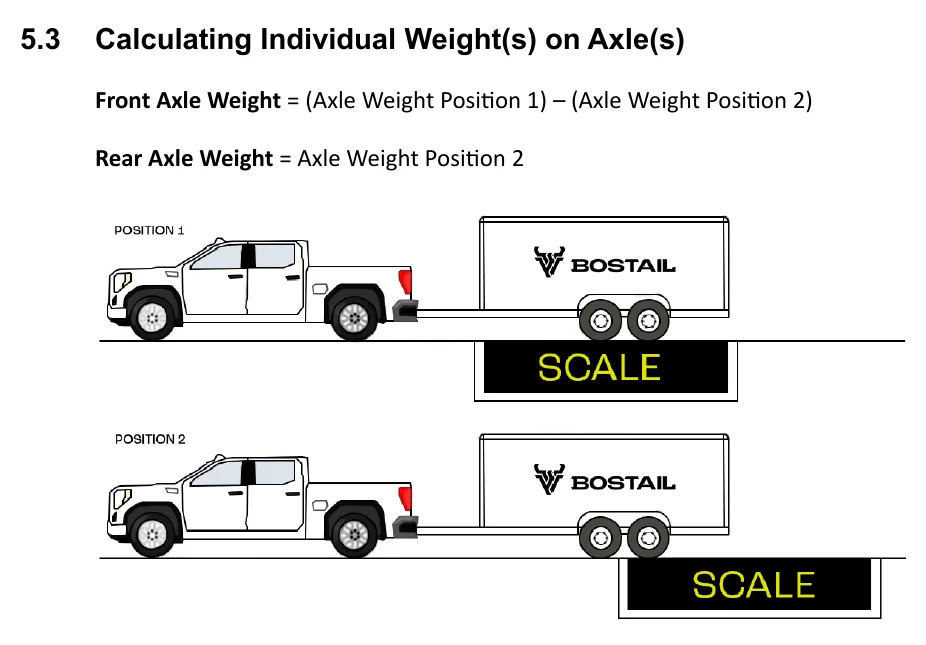
A certified truck scale provides the manual's most accurate method of checking loaded weight distribution. For a tandem arrangement, subtract the second scale-position reading from the first to obtain the front axle load; the second reading is the rear axle load. For a triple arrangement, successive differences give the front and middle axle loads, while the final reading gives the rear load.
How It Works
Loading comes before alignment diagnosis
Load placement affects axle loading, trailer behavior, and component life; excessive concentration toward either end can create uneven axle loading. Overloading changes the center of gravity, promotes premature wear, and can produce sway, so investigate loading before attributing these symptoms to alignment.
Ratings apply to individual components
Read the certification label for gross vehicle and gross axle weight ratings, then check the ratings of the tires and other load-carrying components. Capacity is limited by the weakest rated component, so an acceptable overall trailer weight does not authorize an overloaded axle or tire. Axle totals alone do not establish that each tire is within its rating.
Measure load and attitude under towing conditions
Evaluate the loaded frame on ground that is level lengthwise and across the trailer, and adjust hitch height when necessary for level towing. The manual identifies a certified truck scale as its most accurate method for checking loaded weight distribution, using the illustrated scale positions. For a tandem arrangement, subtract the second reading from the first for the front axle load and use the second reading for the rear; for a triple arrangement, successive differences give the front and middle loads, and the final reading gives the rear.
Step-by-Step Procedure
0/7 doneFigures
Diagnostic Chart
| Symptom | Check | Spec / Expected | Likely cause & fix |
|---|---|---|---|
| Sway with a loaded trailer | Inspect load placement for excessive concentration toward either end, verify loaded weights, and evaluate towing attitude before pursuing alignment correction. | Distribute the load evenly, tow level, and do not exceed vehicle, axle, or tire ratings. | Excessive end loading or overloading may contribute to unstable trailer behavior. Basis: Bostail 8K Axle Manual |
| Loaded frame appears nose-high or nose-low | Confirm the ground is level lengthwise and across the trailer, then step back far enough to view the complete loaded frame in its towing configuration. | The loaded frame should be level with the ground; adjust hitch height when necessary. | Hitch height may be unsuitable, or sloping ground may be misleading the inspection. Basis: Bostail 8K Axle Manual |
| Overall trailer weight appears acceptable, but an axle or tire may be overloaded | Read the certification label and component ratings, obtain axle loads using the illustrated certified-scale positions, and verify individual tire loading rather than assuming equal load sharing. | Respect the weakest rated component and each tire rating; the overall trailer rating does not permit individual axle or tire overload. | Uneven distribution can overload a local component despite an acceptable total trailer weight. Basis: Bostail 8K Axle Manual |
| Calculated axle loads appear inconsistent with the loading | Compare the recorded scale positions and subtraction sequence with the manual's illustrations before accepting the results. | For tandem axles, the first reading minus the second gives the front load, and the second gives the rear; for triple axles, successive differences give front and middle loads, and the final reading gives the rear. | Incorrect scale positioning or subtraction can assign the wrong load to an axle. Basis: Bostail 8K Axle Manual |
At the Bay: Diagnose the Case
CASE 1 / 4
Sway with a loaded trailer
- Test
- Compare
- Correct
Select the next check
Basis: Bostail 8K Axle Manual. A likely cause is a hypothesis; confirm it with the applicable service procedure before repair.
Common Bay Mistakes
- ✕ Treating sway as proof of an alignment fault.
- ✕ Judging trailer attitude on sloping ground.
- ✕ Using total trailer capacity to excuse an overloaded tire or axle.
- ✕ Guessing scale positions instead of following the manual's illustrations.
Quick Check
Practice only — not scored.
Plan the Service Sequence
Planning practice only. Follow the applicable manufacturer's instructions, employer safety program and qualified supervision on real equipment.
Plan the first action. Compare the service steps with the bay mistakes.
Source: Bostail 8K Axle Manual — 11-13, 64-65